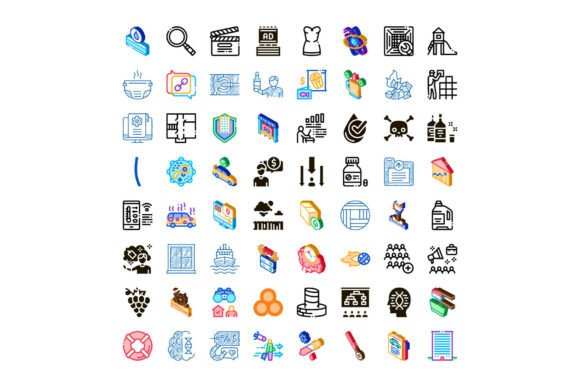
Understanding the Diverse World of Business and Technology Concepts
In today’s fast-evolving digital landscape, the intersection of business and technology has become more complex and dynamic than ever before. From startups to multinational corporations, organizations rely on a wide array of concepts and tools to navigate markets, communicate with customers, and manage internal operations. At the heart of this ecosystem lies a rich collection of business and technology icons—visual symbols that represent everything from finance and advertising to media, environment, and daily life.
What Are Business and Technology Concept Icons?
Business and technology concept icons are visual representations used to simplify complex ideas in a user-friendly way. These icons are commonly used in web and app interfaces to guide users, enhance visual communication, and improve overall user experience. They cover a broad spectrum of themes, including:
- Business: Icons representing teamwork, strategy, leadership, and project management.
- Finance: Symbols for money, investment, budgeting, and analytics.
- Advertising: Icons related to marketing campaigns, social media, branding, and audience targeting.
- Media: Visuals for video, audio, content creation, and streaming services.
- Environment: Symbols for sustainability, green energy, recycling, and eco-friendly practices.
- Daily Life: Icons representing communication, health, time management, and personal productivity.
Why These Concepts Matter in Modern Design
As digital platforms continue to grow in complexity, the need for clear and intuitive design becomes more critical. Icons serve as a universal language that transcends barriers and helps users quickly understand functionality and purpose. Whether you're browsing a website, using a mobile app, or navigating a dashboard, these icons provide immediate visual cues that enhance usability and reduce cognitive load.
For instance, a shopping cart icon on an e-commerce site instantly tells users where to proceed to complete a purchase. Similarly, a lightbulb icon might represent creative ideas or innovation within a collaborative workspace app.
The Role of Icons in Business and Technology Communication
Icons play a vital role in conveying information efficiently. In business environments, they help streamline workflows and improve decision-making. In technology, especially in user interface (UI) and user experience (UX) design, they ensure that applications remain accessible and intuitive for users of all backgrounds.
Consider the use of icons in a productivity app. A calendar icon may represent scheduling, a bell for notifications, and a gear for settings. These symbols help users navigate the app without needing to read lengthy explanations, making the interface more user-friendly and efficient.
How These Icons Reflect Modern Work and Life
The diversity of business and technology icons reflects the multifaceted nature of modern life. Today’s professionals often juggle multiple roles, balancing work, personal development, and digital interactions. Icons help bridge the gap between abstract concepts and real-world applications.
For example, remote work has become a standard in many industries. Icons representing video conferencing, cloud storage, and task management are now essential elements in collaboration tools like Zoom, Slack, and Trello. These visuals help users identify key features at a glance, improving productivity and reducing the learning curve for new platforms.
Environmental and Social Responsibility in Icon Design
With increasing awareness around sustainability and corporate responsibility, environmental icons have become more prevalent. These visuals highlight eco-friendly practices such as recycling, renewable energy, and green transportation. Businesses use these icons to communicate their commitment to sustainability, both internally and to their customers.
For instance, a company might use a leaf icon to denote its carbon-neutral initiatives or a water droplet to represent water conservation efforts. These visual cues not only educate users but also reinforce brand values in a visually engaging way.
Practical Applications Across Industries
Business and technology icons are not limited to any one sector. They appear in a wide range of industries, each with its own unique set of needs and challenges. Here are a few examples of how these icons are applied in real-world scenarios:
- E-commerce: Icons for payment gateways, shipping, returns, and product categories help users navigate online stores with ease.
- Healthcare: Medical apps and websites use icons to represent services like telehealth consultations, prescriptions, and emergency care.
- Education: Learning platforms use icons for course modules, quizzes, and progress tracking to enhance the digital learning experience.
- Finance: Banking apps rely on icons for transactions, account settings, and investment tracking to simplify financial management.
- Creative Industries: Design and media tools use icons for editing, publishing, and sharing content, helping creators focus on their work without distractions.
Common Misconceptions About Icon Usage
While icons are incredibly useful, there are some common misconceptions that designers and developers should be aware of:
- Icons are self-explanatory: While many icons are intuitive, some may be culturally or contextually specific. It’s important to test icons with real users to ensure clarity.
- More icons mean better design: Overloading an interface with too many icons can lead to visual clutter and confusion. Simplicity is key.
- All icons should be minimalist: While minimalism is popular, the design should always prioritize functionality. Sometimes a more detailed icon communicates better than a simplified one.
How to Choose the Right Icons for Your Project
Selecting the right icons involves more than just aesthetics. Here are a few best practices to follow:
- Understand your audience: Consider the cultural and linguistic background of your users to avoid misinterpretation.
- Ensure consistency: Use a unified style across all icons to maintain visual harmony.
- Optimize for scalability: Choose vector-based icons that remain clear at any size.
- Use familiar symbols: Stick to widely recognized icons for common functions like search, settings, and home.
- Test for usability: Conduct user testing to verify that your icons are easily understood and effective.
Conclusion: The Future of Business and Technology Icons
As technology continues to evolve, so too will the role of icons in digital communication. With the rise of artificial intelligence, augmented reality, and voice interfaces, the future of icon design may shift toward more dynamic and interactive visuals. However, the core purpose remains the same: to simplify complex ideas and make digital experiences more intuitive and engaging.
Whether you're a designer, developer, business owner, or everyday user, understanding the significance of business and technology icons can enhance your ability to communicate, collaborate, and innovate in an increasingly connected world. By embracing these visual tools thoughtfully and strategically, we can create interfaces that are not only functional but also inclusive and inspiring.